
 English
数控机床技术
NC Machine Tool Technology Numerical Control (NC) machine tool technology is a cornerstone of modern manufacturing, enabling precise, automated machining of complex parts. NC machines use programmed instructions to control tool movement, eliminating manual operation and significantly improving accuracy, repeatability, and efficiency. Core Principles NC machines operate based on coded instructions, typically written in G-code, which dictate tool paths, speeds, feed rates, and other parameters. These instructions are generated using Computer-Aided Manufacturing (CAM) software, which translates design data from CAD models into machine-readable commands. The machine's controller interprets these commands to drive motors and actuators, ensuring precise positioning of cutting tools relative to the workpiece. Key Components 1. Controller: The brain of the NC machine, executing programmed commands and coordinating movements. 2. Drive System: Includes servo or stepper motors that move the tool or workpiece along multiple axes (e.g., X, Y, Z). 3. Feedback System: Encoders or linear scales monitor position in real-time, ensuring accuracy through closed-loop control. 4. Cutting Tools: High-speed spindles with interchangeable tools perform operations like milling, drilling, or turning. 5. Workholding: Fixtures and clamps secure the workpiece during machining. Advantages - Precision: Tolerances within microns are achievable, critical for aerospace, medical, and automotive industries. - Flexibility: Quick reprogramming allows rapid transitions between different parts. - Productivity: Continuous operation reduces downtime and labor costs. - Complex Geometries: Multi-axis machines (e.g., 5-axis) can produce intricate shapes unattainable manually. Applications NC machines are used across industries: - Aerospace: Machining turbine blades and structural components. - Automotive: Producing engine parts and molds. - Medical: Fabricating implants and surgical instruments. - Electronics: Creating precision components for devices. Evolution & Trends Modern advancements include: - CNC (Computer Numerical Control): Enhanced with onboard computers for real-time adjustments. - IoT Integration: Smart machines with predictive maintenance and data analytics. - Additive Hybrid Systems: Combining subtractive and additive manufacturing. Conclusion NC machine tool technology revolutionized manufacturing by merging automation with precision. As innovations like AI and advanced materials emerge, NC machines will continue driving industrial progress, enabling faster, smarter, and more sustainable production.
产品
分类:
-
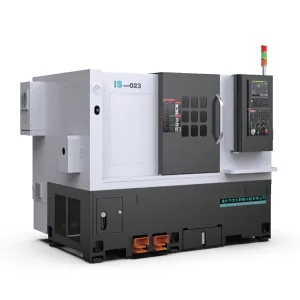
IS-023高精度数控机床
所属分类: IS系列浏览次数: 11编号:发布时间: 2025-12-11 14:06:34IS-023高精度数控机床通过计算机编程实现全自动化控制,具有传统机床无法比拟的三大特点:一是加工精度可达微米级,配合五轴联动技术,可完美处理复杂曲面零件其次,数控机床技术采用高速切削技术,可提高生产效率3-5倍;更重要的是,它具有故障自诊断功能,通过传感器实时监测刀具磨损、温度变化等参数。高精度数控机床采用可靠性增长技术体系,包括建立标准化故障数据库、通过计算机分析故障模式三大核心措施。加强电气系统、冷却系统等薄弱环节设计;利用远程监控实现预测性维护。IS-023高精度数控机床代表了现代制造技术的重大进步。该机床专为满足航空航天、汽车和医疗设备制造等行业的严格要求而设计,集尖端精度、效率和多功能性于一体。...
新闻
分类:
-
[Company News]IS-023高精度数控机床安装调试流程
2025-12-12 17:05:52
案例
分类:
暂无搜索结果!
视频
分类:
暂无搜索结果!
下载
分类:
暂无搜索结果!
招聘
分类:
暂无搜索结果!
推荐产品
暂无搜索结果!



 电话
电话